



Jorge N. Buxton, MD, and Douglas F. Buxton, MD, Microsurgical Education Center
One of the most unique medical training facilities in the Tri State area, the Jorge N. Buxton, MD, and Douglas F. Buxton, MD, Microsurgical Education Center is open and available for use by all interested professionals at New York Eye and Ear Infirmary of Mount Sinai (NYEE).
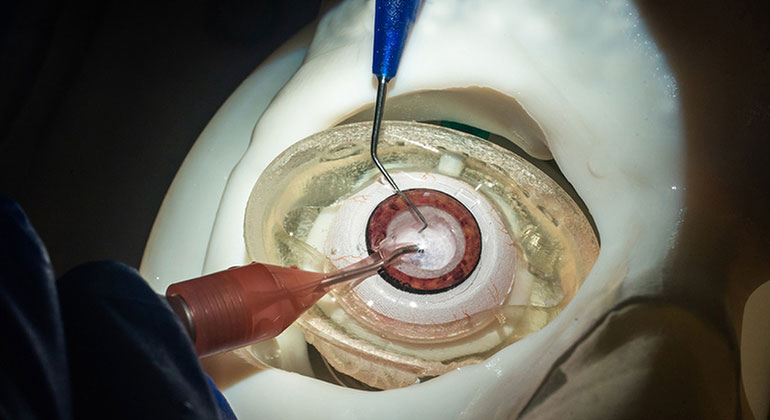
The Center provides ophthalmologists, otolaryngologists and plastic surgeons with opportunities for hands-on experience in a variety of surgical procedures before actually treating patients in the operation room. It is equipped with 16 workstations, each with state-of-the-art operating microscopes and microsurgical instruments. One station is equipped with a chip camera for live demonstrations of surgical techniques. The Center is also equipped with plasma monitors and the latest video technology.
The modern microsurgical laboratory is central to the educational mission of NYEE. Nothing can replace the development of tactile skills and familiarity with three-dimensional anatomical structures.
In ophthalmology, "hands-on" courses include cataract removal, reconstructive plastic surgery, corneal transplantation, non-laser glaucoma surgery, strabismus surgery (muscle surgery to correct crossed eyes), and suturing and incision techniques. Phacoemulsification (used in removal of a cataract) and vitrectomy (removal of the jelly-like matter in the eye to improve vision lost from bleeding in the eye) are practiced on both a simulator and specimens.
In otolaryngology, intensive specialized training is necessitated by the very structure of the human temporal bone, which is one of the most complex in the body; it includes the outer portions of the skull and houses sensitive bones and tissue responsible for hearing and balance. Otologic surgery takes place within an extremely small operative area, and the more important structures are located deep in the head so as to always require delicate microsurgery.
The techniques learned here are used in cases of conductive hearing loss, or loss attributable to non-nerve related problems, such as malfunctioning bones of the middle ear, perforated eardrum from trauma or other causes, or chronic ear disease. Surgical procedures to remedy dizziness and facial paralysis, as well as leading-edge ossicular reconstruction (repair of the hearing bones) are also studied.
Techniques for reconstructive and aesthetic facial surgery have multiplied over the past decade and include endoscopic (performed through small incisions using surgical telescopes) and laser-assisted methods. Over the past several years, the Division of Facial Plastic Surgery within Department of Otolaryngology has become increasingly active in the research, development, and teaching of these new modalities.
The new Center replaced the traditional Temporal Bone Laboratory, which trained more than 2,000 physicians from around the world. Because extensive practice with this part of the anatomy is crucial in developing the expertise necessary to perform delicate surgery in the inner ear and around the facial nerves, NYEE first had a temporal bone laboratory before the turn of the last century.
Formerly The Temporal Bone Laboratory, the Jorge N. Buxton, MD, Microsurgical Education Center officially opened in September 2004 and named in memory of the world-famous corneal surgeon Jorge N. Buxton, MD, who practiced and taught at New York Eye and Ear for more than four decades. The Center was rededicated on September 28, 2021, as Jorge N. Buxton, MD, and Douglas F. Buxton, MD, Microsurgical Education Center to recognize the younger Douglas F. Buxton, MD’s unwavering philanthropic support of NYEE residency and fellowship education.
To learn more about the history of the Buxton Microsurgical Education Center, please read NYEE’s commemorative coffee table book titled A Vision of Hope: The 200-Year History of the New York Eye and Ear Infirmary 1820 – 2020. An excerpt on the Center can be found here.
Courses
The following courses are part of the regularly scheduled curriculum of resident education in Ophthalmology and Otolaryngology at New York Eye and Ear Infirmary of Mount Sinai.
Other offerings will be advertised to their respective specialties in professional journals and online.
Ophthalmology Residents Courses
- First Year Residents *
- Pterygium Surgery
- Strabismus Surgery
- Second Year Residents *
- Glaucoma Surgery
- Penetrating Keratoplasy
- Phacoemulsification (Alcon)
- Vitrectomy surgery
- Third Year Residents
- Introduction to Phacoemulsification - Alcon
- Vitrectomy, advanced
- Introduction to phaco - Bausch and Lomb
- Introduction to phaco - AMO course
- Advanced phaco and Healon 5 Certificate training - AMO course
- AMO course - Tecnis Multifocal Certification
- Suturing Sessions- all residents twice monthly
- Other Ophthalmology Courses
- Neomedix
- IScience Canaloplasty
- Stryker Plating Course - various residents
*offered as annual spring microsurgery courses for residents
Otolaryngology Residents Courses
- First, Second, and Third Year Residents at increasing levels of complexity
- Temporal Bone Dissection
- Plastic surgery flaps and suturing
- Stryker plating course