

Research and Innovation
At New York Eye and Ear Infirmary of Mount Sinai (NYEE), we are striving daily to uncover the next generation of treatments for a wide range of conditions. Never satisfied with the status quo, our scientists work tirelessly to give patients of today and tomorrow new and better options in terms of medications, surgical techniques, prevention practices, and more.
Ophthalmic Research and Innovation at NYEE
Today, more than ever, the pace of scientific research and innovation is the fastest it has ever been, and it requires full commitment, collaborative research, and clinical excellence. NYEE is helping to shape the future treatment and diagnosis of complex eye diseases through the work of a growing team of world-renowned researchers and clinicians at downtown and uptown campuses in Manhattan. Our ability to capitalize on the vast clinical resources of the Mount Sinai Health System, and the research infrastructure of the Icahn School of Medicine at Mount Sinai, allows NYEE specialists greater freedom to purse big ideas, challenge conventional wisdom, and speed the pace of discovery.
In addition to a wealth of clinical trials in ophthalmology, there are four programs helping NYEE advance its pioneering work in the fields of leading-edge ocular imaging, treatment breakthroughs, new surgical devices, and genetics and genomics of eye disease:
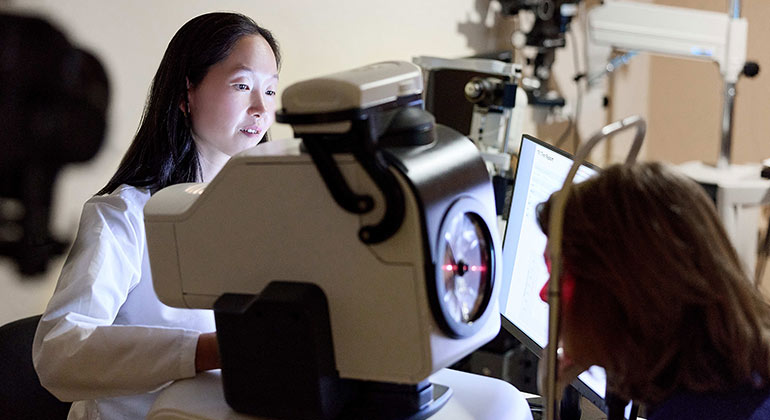
- The Shelley and Steven Einhorn Clinical Research Center of NYEE: This comprehensive venue for major clinical trials is home to a state-of-the-art imaging center.
- Eye and Vision Research Institute at NYEE: This interdisciplinary institute is a hub for faculty, researchers, post-doctoral fellows, and biostatisticians to collaborate in order to develop and share breakthroughs in basic and translational research.
- Ophthalmic Innovation and Technology Program at NYEE: At this Center, new technologies and therapies are developed and commercialized in the form of new products and treatments.
- The Barry Family Center for Ophthalmic Artificial Intelligence and Human Health: The Center is one of the first in the United States dedicated to leveraging the potential of AI, data science, and imaging to achieve breakthroughs in ophthalmic care, and to help bring AI and its rapidly growing family of technologies and capabilities into the ophthalmic mainstream.
Together, these programs allow NYEE to engage in a 360-degree approach to visual science—taking the work from the lab to clinical investigation, and closing the loop with product development to bring cures, novel treatments, and products directly to patients.
Faculty Publications
The renowned faculty and vison researchers at NYEE and the Icahn School of Medicine at Mount Sinai are engaged in groundbreaking research to introduce diagnostic, therapeutic, and surgical treatments to cure blinding diseases, preserve remaining vision, and enhance quality of life.
Click here to view the latest publications and research outputs in ophthalmic and vision research.
Office of Research Services
Research conducted by faculty at the Icahn School of Medicine at Mount Sinai and at the New York Eye and Ear Infirmary of Mount Sinai and its facilities is subject to Mount Sinai’s ethical and legal requirements for the conduct and oversight of human research. The Office of Research Services serves as a central resource for the Mount Sinai Health System research community, and oversight of human subjects research is provided by the Program for the Protection of Human Subjects.