In 1816 two young surgeons of very distinguished parentage, because they were dissatisfied with graduate medical training and because of the lack of knowledge of diseases of the eye in the United States, traveled to the London Infirmary, now the Royal London Ophthalmic Hospital (Moorfields), to study eye disease. The London Eye Infirmary was founded in 1804 by John Cunningham Saunders "out of compassion for the pitiful state of many soldiers returning from the Egyptian campaign afflicted with military ophthalmoplegia and trachoma infections."3 The two surgeons were (1) Edward Delafield, a 22-year-old graduate of Yale University and the College of Physicians and Surgeons and a medical resident at the New York Hospital; and (2) John Kearney Rodgers
(the son of Dr. John R.B. Rodgers, a physician on the staff of the New York Hospital), a 23-year-old graduate of Princeton University and the College of Physicians and Surgeons and a surgical resident at New York
Hospital (illustration, left). Remembering the blind of New York, "who are huddled together with paupers and criminals in the Alms House at Bellevue," Delafield and Rodgers resolved that on their return home they would found an infirmary, the primary objective being, in their own words, "to contribute toward the relief of the poor, who, by a diseased state of one of the most important organs of the human body, are deprived of the means of gaining a
livelihood."3
Dr. Rodgers passed the examination and received a license of
the Royal College of Surgeons before leaving London. When Delafield and
Rodgers returned to New York City in 1818, they found that the two existing
hospitals did not consider eye disease very important and that the poor
received little or no eye care. They could not convince New York City
officials of the need for an eye institution, and because they had no funds,
they entered into private practice. As well as being ophthalmic surgeons,
Edward Delafield was Professor of Obstetrics and Gynecology and Professor of
Diseases of Children at the College of Physicians and Surgeons and later was
to become President of the College of Physicians and Surgeons, and John
Kearney Rodgers was a general and vascular surgeon at New York Hospital. This
diversification reflects the nature and practice of medicine at that time.
Specialization was not looked on with approval during the early 1800's. It was
believed that physicians and surgeons should possess general knowledge and
skills.
TOP
They rented the second floor, a two-room suite, of a small,
two-story brick house at 45 Chatham Square (illustration, left), near Park Row, across
from city hall, and the first patient was treated on August 14, 1820. This
patient was afflicted with a fistula of the lacrimal sac.2 To demonstrate the
good to be derived from such an institution, they agreed to make the effort
and to call for no public assistance until they could show results of a
character and number sufficient to prove how many poor suffered from eye
disease and how much could be done for their relief.
Life in the city was concentrated in the southeastern tip of
Manhattan. Greenwich Village was the northern suburb of the busy seaport of
New York City. Chatham Street was in the midst of the area of New York's
greatest activities. Outpatient professional care and medicines were provided
free of charge. Medical students from Columbia University, who were taught how
to prepare medications and therapies, functioned as apothecaries. The
physicians donated their services for 1 hour 3 days per week. They appointed
Dr. Wright Post and Dr. Samuel Borrowe, who were surgeons at New York Hospital
and "two of the finest physicians of New York City," 4 as consulting
surgeons. This appointment guaranteed respectability and credibility to their
project.
The first annual report of the New York Eye Infirmary was
given at the City Hotel on January 18, 1821, and stated, "1120 persons,
affected with various diseases of the eye, have, in the course of little more
than one year, come forward for relief, and that of this number, 801 have been
cured."5
On March 9, 1821, a meeting was held at the famous City Hotel,
on Broadway between Cedar and Thames Streets. Mr. Jennings, the proprietor,
gave free use of the meeting room at the hotel. This meeting, led by Colonel
William Few, resulted in the permanent organization of the Infirmary. Among
the many persons at this meeting was Philip Hone, later known as the
"gentleman mayor of New York," and Dr. David Hoyack, the most
eminent physician in America, who was the physician who attended Alexander
Hamilton after his famous duel with Aaron Burr. A committee was formed to
solicit subscriptions of well-known and highly esteemed citizens of New York.
A payment of $40 or more would constitute a Governor of Life, and annual
payment of $5, a Governor, and an annual subscription $3, also a Governor, but
one who would only be able to "retain one patient at all times at the
Infirmary, whereas the other Governors could send two sick patients."5 A
society was thus formed, and it consisted of more than 200 members. They
reconvened on April 21, 1821, and named officers and directors of the New York
Eye Infirmary from among the members of New York City's finest families. The
board was called "the Society of the New York Eye Infirmary." Many
were also on the board of the New York Hospital.
Colonel William Few
(illustration, left)
was named president and served from 1821 to 1828. He was a member of the
Constitutional Congress and cosigner of the Constitution of the United States,
a founder of the University of Georgia, and a former Georgia state senator. He
commanded the Georgia State Militia during the Revolutionary War. Colonel Few
moved to New York State in 1799 and became alderman of New York City by
appointment of the Governor of New York State (Kara GB, Personal
communication, September 1995). Colonel Few was a bank president who lived at
221 Broadway, in a home previously owned by Aaron Burr. He retired at the age
of 79 years to Beacon, New York, and died in 1828. He is buried in Beacon, New
York. To this day, it is not known how he became active in the cause of the
Infirmary.
TOP
The bylaws of the New York Eye Infirmary were established and,
for a large part, written by Colonel Few, reflecting very much the style of
the Constitution of the United States. By an act of the legislature of the
State of New York, the charity was incorporated under the name of the New York
Eye Infirmary on March 29, 1822. Diseases of the ear were also treated from
the beginning and recorded as "anomalous diseases." In 1824 an
otology service was officially added. The 1824 Annual Report of the New York
Eye Infirmary stated, "The directors are aware that during the last year,
1823, a new branch has been added to the institution; and patients have been
received and put under treatment, affected with deafness and other diseases of
the ear." 6 Treatment of specific diseases of the ear was first
documented in 18297 and included otorrhea, 27 cases; otitis, 16 cases; ulcer
of the external ear, 2 cases; wax, 9 cases; increased secretion of wax, 3
cases; defective secretion of wax, 7 cases; thickening of the membrane of the
tympanum, 5 cases; tinea auris, 6 cases; erysipelas of ear, 3 cases; closure
of eustachian tube, 4 cases; scrofula of ear, 3 cases; contusion of ear, 5
cases; fungus auris, 2 cases; and deafness, 17 cases.
The official title of the institution was changed, in 1864, to the New York
Eye & Ear Infirmary by an act of the legislature in recognition of the
services rendered, although the surgeons and directors had referred many times
in their annual reports, as early as the 1840's, to the Eye and Ear Infirmary.
In 1822, because of the increasing population of New York City
and the increasing awareness of the existence of the New York Eye Infirmary
and its results of treatment, larger quarters were needed, and the New York
Eye Infirmary moved to 1 Murray Street and Broadway, across from Columbia
College. At this location, an apothecary was appointed to prepare and dispense
medications. In 1824 the Infirmary moved to 139 Duane Street, near lower
Broadway, a portion of a vacant building leased from, and on the grounds of,
the New York Hospital. The building was formerly used to house the insane and
was the former old marine hospital. The leased space consisted of a kitchen
and one room on the first floor and the entire second floor. This lease was
for $500 per year and was made possible by an act of relief from the New York
State legislature, which appropriated $1000 a year for 2 years, for care at
the New York Eye Infirmary, with the stipulation that at least one medical
student from each county of the state be admitted free of charge to observe
medical and surgical treatment at the Infirmary. Inpatient care, and therefore
surgical capabilities, were established at this time. Private patients paid
$2.50 per week. Patients from other states were required to pay for their own
board.
One must wonder what would have happened had the New York
Hospital made the New York Eye Infirmary a permanent part of its structure and
organization. The entire surgical staff were physicians on the staff of the
New York Hospital, and a large number of the Board of Directors were also on
the Board at the New York Hospital. Other cities and major general hospitals
would probably have followed this format, and there would not be the problem
that exists today of freestanding eye and ear hospitals attempting to
reaffiliate with general hospitals and universities for survival in this era
of cost containment and managed care, and there would not be the duplication
of services that exists between the general hospitals and specialty hospitals.
But perhaps this separation helped to free ophthalmology and otolaryngology to
expand to the levels they have achieved, unencumbered by the larger issues and
problems of the general hospital.
TOP
John Delafield, Jr, Treasurer of the New York Eye Infirmary
and brother of Dr. Edward Delafield, was charged with the task of developing a
seal for the Infirmary. He and a committee put forth, and the directors
adapted this seal on July 21, 1824, and depicted "the great physician
restoring sight to a man born blind, the seal stands as a symbol of the
religious background and piety of its founders." 8,9
There were many other moves of the New York Eye & Ear
Infirmary (illustration, left - click the image to enlarge): in 1827 to 459 Broadway, in 1834 to 96 Elm Street on the
corner of Walker Street, and in 1840 to 45-47 Howard Street near Broadway. The
surgeons called to the attention of the Board of Directors and to the
citizenry of New York City the need for a building erected with special
reference to the wants of the Infirmary: "Besides the poor of our own
city, there are patients from every county of the state, and even from other
states, that avail themselves of our benefits."10 The next year, in May
of 1845, the Infirmary moved to 97 Mercer Street, between Spring and Prince
Streets, the first structure purchased by the New York Eye Infirmary, and it
cost $7000. The Infirmary very quickly outgrew this space because of the
market demand for services and the recognition of excellent care and results.
The Board of Surgeons again appealed to the Directors in a very articulate
presentation for the need for larger and more permanent quarters.11 They
stated that "this Infirmary was the first established in America, and
though situated in the largest and most wealthy city of this country, its
financial history presents a strong contrast with that of similar institutions
in Boston and Philadelphia."11
Within a few years of the beginnings of the New York Eye
Infirmary, because of the success of treatment rendered, similar institutions
were established in Boston and Philadelphia. The Massachusetts Charitable Eye
and Ear Infirmary was established in Boston in 1824 by Dr. Edwards Reynolds, a
friend and fellow student of Drs. Delafield and Rodgers. In 1850 a beautiful
and commodious building was erected, and it is a lasting monument to the
liberality of the State of Massachusetts and the benevolence of the citizens
of Boston. In Philadelphia, the Wills Hospital similarly was constructed and
stood as a monument to its citizenry. The population of New York City
continued to explode, and the patients were coming to the Infirmary from all
over the state and country, and several from other countries. Petitions were
constantly being submitted by the surgeons and directors of the New York Eye
Infirmary to the citizenry of New York and the state legislature for financial
support for a new building.
At about this period, in October of 1846, Dr. W.T. Morton, a
Boston dentist, administered the first ether anesthetic at Massachusetts
General Hospital. It is reported that 31 days later, John Kearney Rodgers used
an ether anesthetic for the drainage of a perirectal abscess and was
considered one of New York's foremost general surgeons.12 At the New York
Hospital, in approximately 1848, he ligated the innominate artery, a procedure
that had never been successfully performed before. Dr. Cornelius Rea Agnew
(1830-1888), a surgeon at the New York Eye & Ear Infirmary, founded the
Brooklyn Eye and Ear Infirmary in 1868 and the Manhattan Eye and Ear Infirmary
in 1869.
Dr. Gurdon Buck, an attending physician at the New York Eye & Ear
Infirmary from 1851 to 1860 and a visiting surgeon at the New York Hospital,
was a founding fellow of the New York Academy of Medicine in 1847. He was well
known for his facial plastic and reconstructive surgery and made enormous
contributions to the development of clinical photography. He made routine use
of photographs to document his surgical cases before and after operations. He
was also known as the "father of intralaryngeal surgery" because of
his method of laryngofissure in the treatment of laryngeal carcinoma. Before
the invention of the laryngoscope, he developed a technique that reduced edema
of the glottis,13 thereby preventing suffocation. He also made contributions
to orthopedic traction (Buck's extension) and anatomy of the genitourinary
tract. Buck's fascia was named for him.
TOP
Ten thousand dollars was awarded by the State of New York,
provided the Infirmary would be able to raise $20,000 by subscription, and
another $10,000 was added for the total purchase of the land and construction
costs. On April 25, 1856, a four-story brownstone on 13th Street and Second
Avenue, in what was then a very fashionable neighborhood, was purchased (illustration,
right). There were first-floor clinics and 40 to 50 inpatient beds. Minutes from
meetings in 1858 and 1859 mentioned the terms outdoor patients and indoor
patients. In 1857 the Infirmary was open 5 days per week, with 2 days fully
devoted to ear diseases. In 1862 the first house surgeons was appointed,
although teaching always had been performed. Training was in both eye and ear
diseases.
The arguments for the growth and existence of the Infirmary
continued and were reviewed by Dr. Delafield in his address at the dedication
of the new building of the New York Eye Infirmary on April 25, 1856. He said:
"The public seems to forget that the comparatively small
sums necessary to sustain these charities [infirmaries and dispensaries] save
thousands upon thousands [of dollars] in the way of taxes for support of alms
houses, blind institutions, etc…. Thus the rich, in contributing to the
support of this and other kindred charities, benefit not only the poor but
indirectly themselves by affording opportunities to those who may one day
become their own medical advisors to fully qualify themselves for their
professional duties."14
The lectureships established in the Infirmary in 1823 were
probably the first organized efforts at teaching ophthalmology in the United
States, which in part helps explain why Drs. Rodgers and Delafield are often
considered the "fathers of American ophthalmology," a term first
used in 1850 by Dr. Edward Reynolds, their friend and founder of the
Massachusetts Charitable Eye and Ear Infirmary. Edward Delafield was founder
and first president of the American Ophthalmological Society in 1864.
Although Drs. Delafield and Rodgers actions since 1816 spoke
for their belief in specialization, their string convictions as to the need
for specialized eye and ear care were articulated in Delafield's dedication
address for the New York Eye Infirmary building:
"But I may be asked why should the surgery of the eye and
ear be separated from the main body of the science? Why should a distinct
infirmary be established for the relief of those who suffer under diseases of
these organs? And why should a separate course of lectures be thought
necessary to teach their nature and treatment?... Take also the general fact,
which is incontestable, that no progress was made in the pathology and
treatment of these diseases until they began to be taken up separately and
distinct charities founded for their treatment."14
He used the London Eye Infirmary as his model:
"No human being can possibly be thoroughly versed in
every part of our science and art ... he may be an excellent general
practitioner, but he cannot equally well treat every difficult case he may
meet with ... but I would by no means advocate the entire separation of this
or any other class of diseases from the general practice of medicine. All
experience has shown that individuals who have never pursued the general
practice of medicine and surgery and who have abandoned it and devoted
themselves to [eye] surgery alone...have generally degenerated into
empiricism."14
TOP
In 1873 a throat department was added. The throat department
received authorization to exist from the State Department of Legislature in
1874. Of relative historic interest, the first solely ear, nose, and throat
institution in the United States was the Metropolitan Throat Hospital and
Dispensary of New York, founded in 1873 by Clinton Wagner and Dr. David
Delavan, a consultant at the New York Eye & Ear Infirmary.
The physical structure of the Infirmary underwent many modifications and
additions, which were made necessary by the volume and diversity of medical
and surgical diseases of the eye and ear and were made possible by constant
fund-raising. In 1868 the directors passed a resolution "that any person
giving the sum of $4,000 will found a permanent free bed. This bed will,
during the lifetime of the donor, be occupied by such patients as he may
designate. After his death, the bed will remain free for the use of poor
patients and will bear the name of the donor inscribed upon it."15 The
Life Governors and Subscribers include the who's who in New York City society:
Agnews, Astors, Delafields, Delavanes, Dubois, Lenoxes, Macys, Phelps,
Rhinelanders, Wainwrights, Vanderbilts, and Roosevelts, to name just a few.
Construction of the Brooklyn Bridge began in 1870; it was
designed by John Rogland and continued by his son 18 years later.
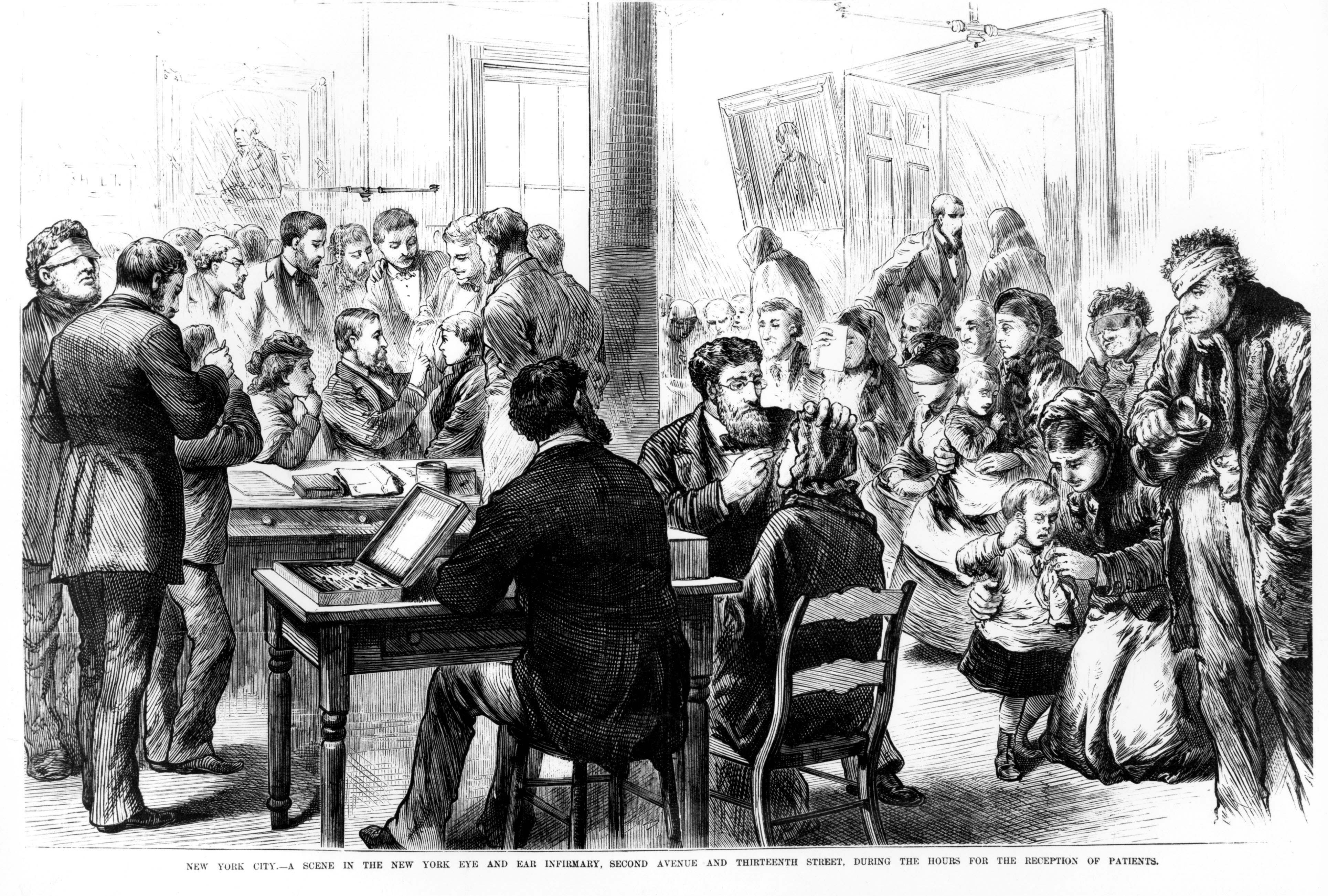
In 1870 the Infirmary expanded to 75 inpatient beds, 2
full-time nurses, and 23 eye and ear surgeons (illustration, left; from Frank
Leslies Illustrated Newspaper, NYC, April 10, 1875). One house surgeon and
two consulting surgeons lived in the building. In 1890 the brownstone building
was torn down and replaced, and in 1890 to 1893 three floors were added to the
restored brownstone.
In 1890 a state-chartered school of ophthalmology and
otolaryngology (a postgraduate institute) and a school for nurses relative to
eye and ear disorders were established.
The
New York Eye & Ear Infirmary Reports, the journal of
the New York Eye & Ear Infirmary, was established in 1891, and the first
issue was published in January 1893 (photo, right -
click the image to enlarge). The following reports were
included in that first issue: a case of suppurative otitis media, a report of
15 cases of mastoiditis, seborrheic affections of the external ear, adenoid
growths as a cause of ear diseases in children, and primary chondritis of the
larynx.
In 1895 Gugliamo Marconi pioneered wireless telgraphy.
In 1896 the eye and ear services were separated.
In 1896, Henry Ford produced his first car.
TOP
The annual report of the New York Eye & Ear Infirmary of
1897 stated, "Patients are to be received in the wards of the institution
free of all charge for medical attendance, but in all cases where patients are
able to pay, a charge of $7 per week is made to meet the expenses of
board." The dispensing department is for the free medical and surgical
treatment of the deserving poor, but no patient able to pay is accepted for
treatment." It also stated, "In conducting the hospital work of the
Infirmary, it was deemed appropriate to appoint a separate house staff, and
thus the eye and ear services were divided."16
In 1900
(photo, left) the Platt Pavilion for contagious diseases of
the eye was added to the restored brownstone. At this time Dr. R. Derby,
Executive Surgeon Director, Otology Department, made a plea to the Board of
Directors because of the growth of the aural department for "priority
consideration for added space in operating rooms for aural patients."
"The meager conveniences or, better said, their necessities afforded the
aural department for the care of its capital operations are in painful
contrast to the satisfactory accommodations provided the eye department for
its cataract cases." "The average cataract patient of the clinic is
old and a charge upon his relatives; the restoration of sight is, in the
majority of cases, a temporary boon only, which the limitations of age must
speedily terminate. The average intracranial case, on the other hand, is of
middle age or younger.... Aural surgery today deals with questions of life and
death."17
In 1903 the Schermerhorn Pavilion for diseases of the ear was
completed.
The throat department was deleted in name only in 1902 because
of the marked growth of the eye and ear sections. At this time the staff
consisted of 31 surgeons, 56 assistant surgeons, and 12 house staff. 18
Between 1820 and 1903 patients were never charged a clinic
fee. In 1903 the fee was 25 cents. Only 40% of the patients paid this fee.
This clinic fee lasted 50 years.
The inpatient charge was $7.50 per week for clinic patients,
$15 per week for semiprivate patients, and $25 per week for private patients.
In 1902 the first electric hearing aid was invented.
New
York had its first subway in 1904.
The Clinical Congress of the American College of Surgeons was
held at the New York Eye and Ear Infirmary in October 1924.
The first two examining boards in American medicine had their
origin from the old Academy (the American Academy of Ophthalmology and
Otolaryngology). The American Board of Ophthalmology was established in 1917,
and the American Board of Otolaryngology established in 1924. 19 These two
boards, along with the American Board of Obstetrics and Gynecology in 1930 and
the American Board of Dermatology in 1932, formed the American Board of
Medical Specialties in 1935, which now recognizes 24 specialty boards. The
American Board of Facial Plastic and Reconstructive Surgery is currently
seeking recognition.
The otolaryngology section of the American Academy of
Ophthalmology and Otolaryngology selected the New York Eye & Ear Infirmary
as the site of its annual meeting in 1936.
TOP
In 1935 to 1936 the first wearable hearing aid was produced;
it weighed two and a half pounds.
In 1938 an agreement was reached with the Columbia University
College of Physicians and Surgeons whereby house officers of the New York Eye
and Ear Infirmary could take a basic science course at Columbia Presbyterian
Hospital. House officers who availed themselves of this privilege became
eligible to receive a degree from Columbia University, as well as a diploma
from the New York Eye and Ear Infirmary.
In 1940 all phases of expansion of the Infirmary were halted
because of World War II. Intern quarters were changed to semiprivate rooms,
and house officers' accommodations were moved to a residence on 14th Street.
In 1943 a new building was constructed in the courtyard to
house the X-ray Department, the Bronchoscopy Department, and the Department of
Research.
The patients treated since the opening of the Infirmary on
August 14, 1820, represent all the nations of the Earth, white and black, free
man and slave, veterans of the American Revolution, soldiers of the Duke of
Wellington and Napoleon who crossed the sea, widows and orphans, all who have
sought aid and have been administered to.20
In 1943, 132 staff physicians were in the Armed Forces,
causing a shortage of staff. Therefore the entire teaching program of the New
York Eye and Ear Infirmary was placed under the guidance of the College of
Physicians and Surgeons of Columbia University. Dr. J. Morisset Smith, the
Executive Surgeon Director, was given the title of Professor of Otolaryngology
and Executive Director of the Department.
The postwar years brought continued growth at the Infirmary.
The clinics flourished, and the staff greatly expanded. In 1968 the North
Building was dedicated, and the South Building was renovated. The New York Eye
and Ear Infirmary at that time contained 207 beds and 10 operating rooms.
Since its founding in 1829, the New York Eye and Ear Infirmary
never closed its doors, except for 3 months in 1822 during an epidemic of
yellow fever, when all who could fled to the northern section of the city
(Greenwich Village).
The New York Eye and Ear Infirmary is recognized as the oldest
continuously existing specialty hospital in the western hemisphere. Its staff
physicians were involved with nearly all ophthalmology and otolaryngology
advances and organizations in New York City.
The New York Laryngological Society, the first of its kind in
America, was founded October 13, 1873, by several physicians of the New York
Eye & Ear Infirmary and others. To this date Infirmary physicians have
been represented significantly. The New York Laryngological Society was the
father society to the American Laryngological Society, which was founded in
1878.20
TOP
Arthur Duel (of facial nerve surgery fame) was one of the
leaders at the New York Academy of Medicine and chaired the Otolaryngology
Section at the turn of the century. He was influential in acquiring the site
of, and in the construction of, the New York Academy of Medicine building on
103rd Street. He was a consultant at the New York Eye & Ear Infirmary.
The New York Otologic Society was founded on May 17, 1892. One
of the founding physicians (Dr. Edward Dench) was a Surgeon Director at the
New York Eye & Ear Infirmary.
Horace Green, a consultant at the New York Eye & Ear
Infirmary in 1846, was considered by many to be the father of laryngology in
New York City and one of the founders of the New York Medical College.21
In 1884 Karl Koller discovered cocaine and its use as a
topical anesthetic. The first institution he lectured at in America was the
New York Eye & Ear Infirmary.
Ed Burchell (1872-1960), who was at the Rockefeller Institute,
was brought to the Infirmary before World War I. 22 For the next 50 years, he
was revered throughout America for his temporal bone dissections and
histological preparations (Kara CB, Personal communication, 1980). Dr.
Burchell was inducted as the first honorary member of the American Academy of
Ophthalmology and Otolaryngology in 1944. (Weymuller EA, Personal
communication, 1980).
There have been many other local, national, and international
leaders in otolaryngology who have been members of the staff of the New York
Eye & Ear Infirmary. Time does not permit their listings and biographies.
In 1960 the New York Eye & Ear Infirmary had 104,000 total
clinic visits; 29,000 ear, nose, and throat clinical patients were treated,
and 2450 ear, nose and throat surgical procedures were performed. Gordon
Braislin was President of the Board of Trustees. Colonel Charles E. Martin was
the administrator. The Surgeon Directors, Department of Otolaryngology, were
Drs. J. Swift Hanley, Earl Limbach, Greydon Boyd, Ernest Weymuller, Ward
Dennison, and Arthur Cracovaner. Attending surgeons were Drs. Daryl Voorhees,
Francis Fodor, Paul Chodosh, and Felix DePenies, and listed as a resident at
that time was Dr. Hector Giancarlo; all were destined to be Surgeon Directors,
Otolaryngology, within that decade.
The Research Department, cochaired by Dr. Godfrey Arnold, was
very active and participated in many National Institutes of Health, U.S. Army,
U.S. Air Force, and Deafness Research foundation investigations, and in 1960
Dr. Arnold received the Harris P. Mosher Award for his triologic thesis,
"Physiology and Pathology of the Cricothyroid Muscle."
In 1961 Dr. Daryl Voorhees replaced Dr. Greydon Boyd, and in
1963 Dr. Felix DePenies replaced Dr. Ward Dennison as Surgeon Director.
Clinical audiology was introduced at the Infirmary in 1945 to meet the needs
of returning World War II veterans with service-connected hearing loss. This
center developed into a sophisticated center for the evaluation of speech,
hearing, and balance disorders. In 1961 the Department of Audiology's name was
changed to the Hearing and Speech Department. The Director was Irwin Malles,
Ph.D., who succeeded Mr. James A. DePew, Jr. The center is now the Hector
Giancarlo Department of Communication Disorders.
TOP
In 1961 Dr. Watson Crick made a model of DNA.
In 1966 the Surgeon Directors, Otolaryngology, were Drs. Daryl
Voorhees, Earl Limbach, Paul Chodosh, Felix DePenies, Ernest Weymuller, and
Ricardo Bisi.
Satisfactory completion of the otolaryngology residency
required, among other things, a 1-year basic science course, completion of the
home study course of the American Academy of Otolaryngology, and completion of
an original basic clinical research project.
In 1968 there were 103,415 total clinic visits, 30,514 of
which were otolaryngology visits, and 3065 ear, nose, and throat surgical
procedures were performed. Dr. Ernest Weymuller, Executive Surgeon Director,
Otolaryngology, appointed a full-time Director of Resident Education. The
reputation of the Infirmary grew worldwide, and patients continued to come for
medical attention from around the world. To meet the increased demand for
services and the need for more space (the infirmary had been at the same
location since 1856), the dream of decades was achieved in January 1968, when
the new 107-bed modern voluntary hospital building was opened at 310 East 14th
Street.
A voluntary hospital operates as a nonprofit corporation,
depending on contributions and endowments to cover its operating costs. As
always in the past, the funds necessary had to be raised by the Board of
Trustees and medical staff of the New York Eye & Ear Infirmary under the
leadership of Gordon S. Braislin, President of the Board of Directors.
The New York Eye & Ear Infirmary complex consisted of
three buildings: the newly dedicated north building; the historic south
building, which included a ten-station temporal bone microsurgical laboratory,
anatomic dissection laboratory, and historical medical library; and the
123-unit apartment building to house the house staff and nurses, which was
completed in 1974.
Infirmary graduate surgeons are found throughout the United
States and abroad. Many have excelled in their specialty and have occupied
chairs in ophthalmology and otolaryngology in medical centers throughout the
world.
TOP
In 1969 Neil Armstrong became the first man to walk on the
moon.
In 1972 the computerized axial tomography (CAT scan) imaging
system was introduced for medical diagnosis and research.
In 1973 magnetic resonance imaging (MRI) was developed for
medical diagnosis.
In September 1980 an affiliation agreement was signed with New
York Medical College. New York Medical College, owned by the archdiocese of
New York and located in Valhalla, New York, is the third largest private
medical university in the United States and the largest in New York State. Its
affiliation with Metropolitan Hospital is the oldest continuing affiliation in
the nation between a private medical school and public hospital, and it was
the first medical college to own its own teaching hospital (1889), the Flower
Fifth Avenue Hospital, named after Roswell Flower, who later became Governor
of New York State.
In 1982 the first transplant of an artificial heart, Jarvik7,
was accomplished.
To further strengthen this affiliation and its teaching
program, the Surgeon Directors, Otolaryngology (Executive Surgeon Director Dr.
Kenneth Mattucci, Dr. Paul Chodosh, Dr. Y.B. Choo, Dr. Hector Giancarlo, Dr.
Felix DePenies, and Dr. Stanley Blaugrund), in 1983- with the approval of the
medical staff, medical board, and board of trustees- changed the Infirmary
from a horizontally oriented, six chief, surgeon director-led service, present
for more than 100 years and serving the Infirmary well, to a more traditional,
vertically integrated format. A search was made for the first Professor and
Chairman of the Department of Otolaryngology- Head and Neck Surgery of the New
York Medical College and the New York Eye & Ear Infirmary.
Dr. Daniel
Rabuzzi, from Syracuse, was recruited and served with distinction
until 1984. Dr. Frank Lucente followed and further strengthened and
expanded our institution and teaching program to one of the greater national
prominence. In 1992 Dr. Steven Schaefer assumed the role of
Professor and Chairman, Joseph Corcoran became Chief Executive Officer, and
Joseph Burkart became President of the Board of Trustees.
TOP
At present the New York Eye & Ear Infirmary continues to
grow and expand beyond the north and south buildings. Significant renovations
of the existing structure are ongoing, providing ambulatory surgery
facilities, private office space, expanded outpatient facilities, and support
services. There were 57,000 ear, nose and throat clinic visits, 2500 ear,
nose, and throat ambulatory surgery procedures, and 1300 ear, nose, and throat
inpatient procedures performed at the Infirmary in 1994. The total number of
patients treated at the New York Eye & Ear Infirmary in 1994 was 164,500,
quite a remarkable contrast to the 1102 patients treated in 1820. There are
presently 37 residents, 16 of whom are otolaryngology house staff, many
fellows, 544 physicians and surgeons, 81 full-time registered nurses, and 74
part-time registered nurses. In 1994 U.S. News and World Report ranked the
Department of Otolaryngology of the New York Eye & Ear Infirmary first in
the State of New York and third in the United States.23
With the solid base and background, with continued strong
leadership and full-time and voluntary staff cooperation, I can see continued
growth and success as a nationally recognized teaching and research center and
provider of specialty medical and surgical care.
No historical sketch, however short, could end without
reference to the illustrious laymen, our benefactors and directors, who from
the days of Colonel William Few of revolutionary fame, the first President of
the Board of Governors of the Infirmary, have made it possible for a long line
of devoted and skillful surgeons to do such a vast deal, uninterruptedly, for
more than 140 (now 175) years, for the relief of human suffering.
Their Spirit Lives with Us for Evermore" (Annual Report
of the New York Eye & Ear Infirmary, 1940).
TOP
REFERENCES