|
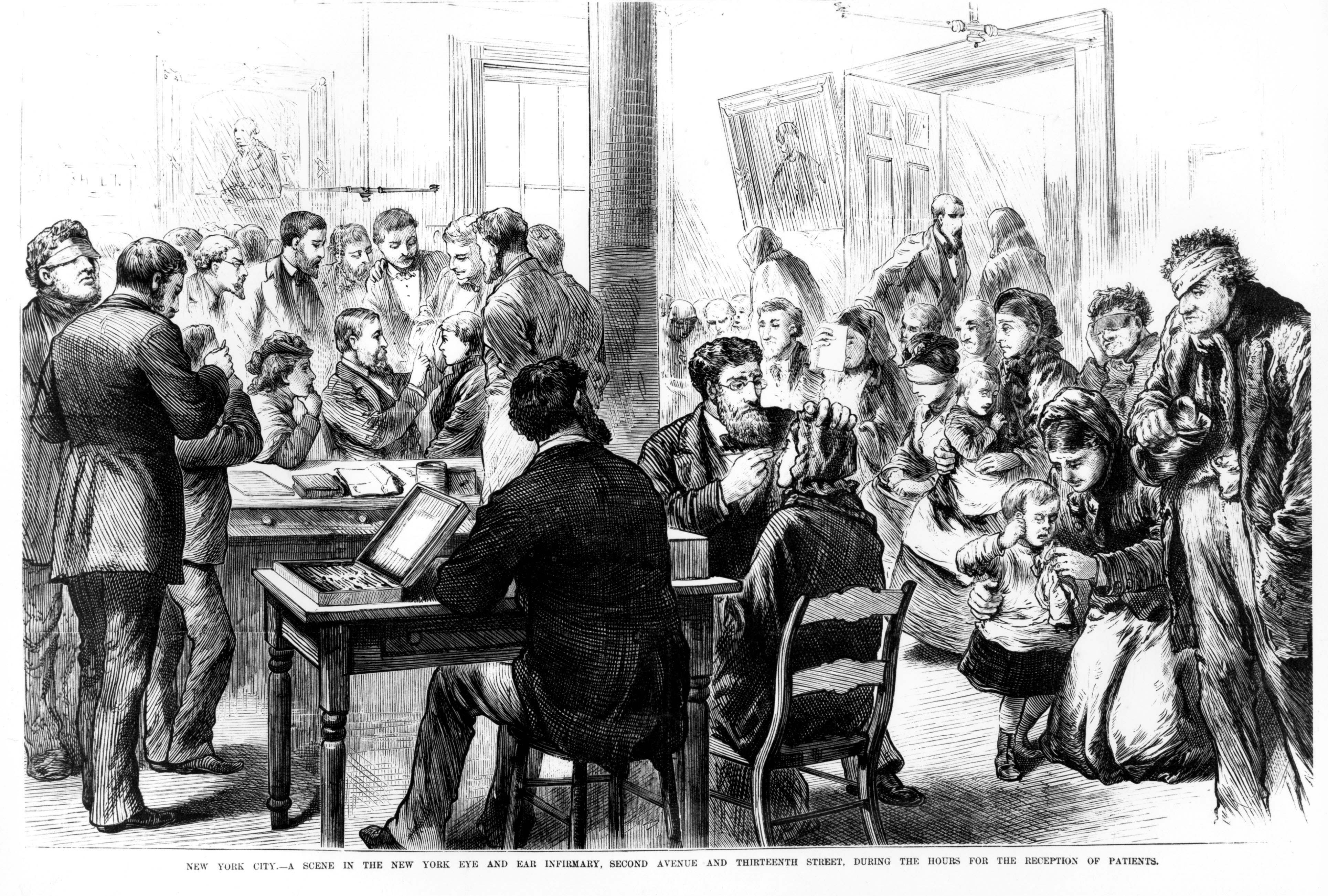
They rented the second floor, a two-room suite, of a small, two-story brick house at 45 Chatham Square (Fig. 3), near Park Row, across from city hall, and the first patient was treated on August 14, 1820. This patient was afflicted with a fistula of the lacrimal sac. 2 To demonstrate the good to be derived from such an institution, they agreed to make the effort and to call for no public assistance until they could show results of a character and number sufficient to prove how many poor suffered from eye disease and how much could be done for their relief. Life in the city was concentrated in the southeastern tip of Manhattan. Greenwich Village was the northern suburb of the busy seaport of New York City. Chatham Street was in the midst of the area of New York's greatest activities. Outpatient professional care and medicines were provided free of charge. Medical students from Columbia University, who were taught how to prepare medications and therapies, functioned as apothecaries. The physicians donated their services for 1 hour 3 days per week. They appointed Dr. Wright Post and Dr. Samuel Borrowe, who were surgeons at New York Hospital and "two of the finest physicians of New York City," 4 as consulting surgeons. This appointment guaranteed respectability and credibility to their project. The first annual report of the New York Eye Infirmary was given at the City Hotel on January 18, 1821, and stated, "1120 persons, affected with various diseases of the eye, have, in the course of little more than one year, come forward for relief, and that of this number, 801 have been cured." 5 On March 9, 1821, a meeting was held at the famous City Hotel, on Broadway between Cedar and Thames Streets. Mr. Jennings, the proprietor, gave free use of the meeting room at the hotel. This meeting, led by Colonel William Few, resulted in the permanent organization of the Infirmary. Among the many persons at this meeting was Philip Hone, later known as the "gentleman mayor of New York," and Dr. David Hoyack, the most eminent physician in America, who was the physician who attended Alexander Hamilton after his famous duel with Aaron Burr. A committee was formed to solicit subscriptions of well-known and highly esteemed citizens of New York. A payment of $40 or more would constitute a Governor of Life, and annual payment of $5, a Governor, and an annual subscription $3, also a Governor, but one who would only be able to "retain one patient at all times at the Infirmary, whereas the other Governors could send two sick patients." 5 A society was thus formed, and it consisted of more than 200 members. They reconvened on April 21, 1821, and named officers and directors of the New York Eye Infirmary from among the members of New York City's finest families. The board was called "the Society of the New York Eye Infirmary." Many were also on the board of the New York Hospital. Colonel William Few (Fig. 4) was names president and served from 1821 to 1828. He was a member of the Constitutional Congress and cosigner of the Constitution of the United States, a founder of the University of Georgia, and a former Georgia state senator. He commanded the Georgia State Militia during the Revolutionary War. Colonel Few moved to New York State in 1799 and became alderman of New York City by appointment of the Governor of New York State (Kara GB, Personal communication, September 1995). Colonel Few was a bank president who lived at 221 Broadway, in a home previously owned by Aaron Burr. He retired at the age of 79 years to Beacon, New York, and died in 1828. He is buried in Beacon, New York. To this day, it is not known how he became active in the cause of the Infirmary. The bylaws of the New York Eye Infirmary were established and, for a large part, written by Colonel Few, reflecting very much the style of the Constitution of the United States. By an act of the legislature of the State of New York, the charity was incorporated under the name of the New York Eye Infirmary on March 29, 1822. Diseases of the ear were also treated from the beginning and recorded as "anomalous diseases." In 1824 an otology service was officially added. The 1824 Annual Report of the New York Eye Infirmary stated, "The directors are aware that during the last year, 1823, a new branch has been added to the institution; and patients have been received and put under treatment, affected with deafness and other diseases of the ear." 6 Treatment of specific diseases of the ear was first documented in 1829 7 and included otorrhea, 27 cases; otitis, 16 cases; ulcer of the external ear, 2 cases; wax, 9 cases; increased secretion of wax, 3 cases; defective secretion of wax, 7 cases; thickening of the membrane of the tympanum, 5 cases; tinea auris, 6 cases; erysipelas of ear, 3 cases; closure of eustachian tube, 4 cases; scrofula of ear, 3 cases; contusion of ear, 5 cases; fungus auris, 2 cases; and deafness, 17 cases.
|