|
|
 |
|
The origin of The New York Eye and Ear Infirmary dates to 1816, when two young graduates of the New York College of Physicians and Surgeons, Edward Delafield, a medical resident, and John Kearney Rodgers, a surgical resident, set out from New York to continue their medical training in London. There they met Edward Reynolds, M.D., who introduced them to the London Infirmary for Curing Diseases of the Eye, later famed as the Royal London Ophthalmic Hospital
(Moorfields). The two Americans enrolled in the ophthalmic training program and studied there for the next two years under the tutelage of Sir William Lawrence, Benjamin Travers, John Richard
Farre, and Sir Astely Cooper.
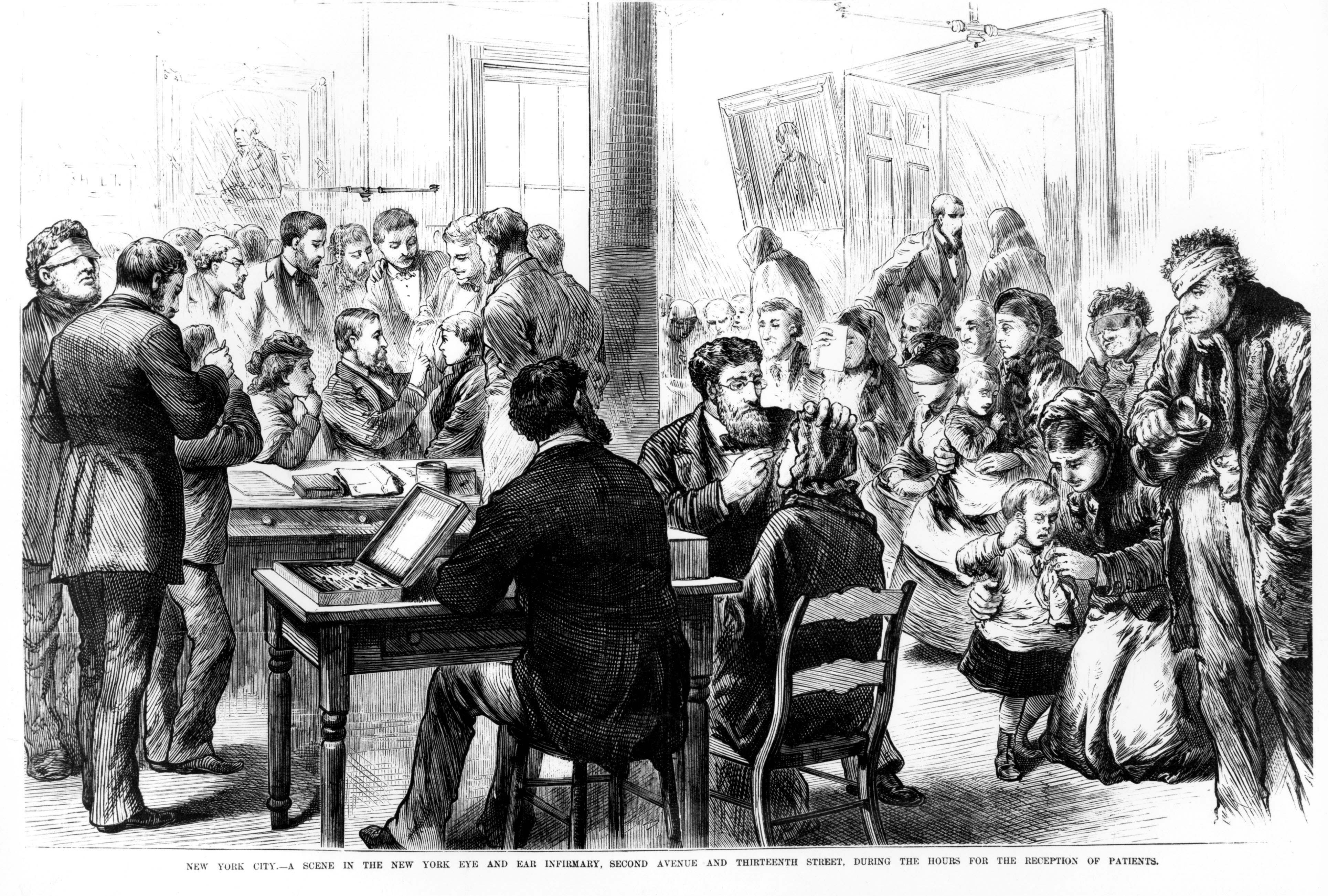
In 1818, Delafield and Rogers returned to New York City, surveyed the incidence of eye disease in the population and concluded that existing facilities were inadequate to manage the volume of indigent patients requiring ophthalmic care. Realizing the lack of interest in their project, they determined to finance their charity personally and on August 1, 1820, the original Infirmary was opened.
TOP
The young founders gathered prominent members of the business and medical communities to serve as a Board of Directors, the "Society for the New York Eye Infirmary." From 1821-28, the first President of The New York Eye and Ear Infirmary Board was one of the nation's most respected citizens,
Col. William
Few, then 72 and a retired banker. In his earlier years Col. Few fought in the Revolutionary War and had the distinction of being a signer of the U.S. Constitution. Although ears had been treated at The New York Eye and Ear Infirmary since its inception, the institution was originally incorporated under the title of The New York Eye Infirmary on March 22, 1822. In 1864, the otology department was given official recognition and the name was legally changed to The New York Eye and Ear Infirmary. In 1873, the throat department was added. The New York Medical College, our sister institution, has a long ophthalmology history. In 1872, the Medical College moved from its original home in Manhattan on 20th Street & Third Avenue to more spacious quarters at 23rd Street & Third Avenue, renting space from the New York Ophthalmic Hospital (founded in l852). The College added to the faculty a chair of Ophthalmic Surgery and named Prof. C. T. Liebold as the first occupant of this chair. The Ophthalmic Hospital was merged into the Medical School in 1867. This afforded graduate facilities for interested individuals to study Ophthalmology and Otolaryngology--an Oculi et Auri degree. This merger allowed students excellent training in diseases of the eye and ear. Beginning in 1867 Ophthalmology and Rhinolaryngology were independent departments from surgery. Today, New York Medical College is located a few miles north of New York City, in Valhalla. Although teaching had been conducted at The New York Eye and Ear Infirmary from the very beginning, the School of Ophthalmology and Otolaryngology, chartered by the State Legislature, was officially founded in 1890. Thus began the first Otolaryngology resident training program in the United States. At that time, training for ophthalmology and otolaryngology was combined. It was not until 1896 that the services were separated. Clinical audiology was introduced at The New York Eye and Ear Infirmary in 1945 to meet the needs of returning World War II veterans with service-connected hearing deficits. From its informal inception with no professional standards for audiologists and "home spun" testing equipment, the department has evolved into a sophisticated center for the evaluation of hearing, speech and voice disorders, balance, and the facial nerve. Since its founding, The New York Eye and Ear Infirmary has remained in the forefront of its specialty in America. Almost every state in the US, and many foreign countries, are represented in The New York Eye and Ear Infirmary's roster of graduates and post-graduate students, many of whom have gone to illustrious careers.
TOP
|
 |
 |
Histories
from Two Different Perspectives Two dedicated physicians intensively researched the history of The New York Eye and Ear Infirmary and of the development of their medical specialties in America. View the papers in their respective fields:
TOP
Mission
Statement of The New York Eye and Ear Infirmary
The
New York Eye and Ear Infirmary was established in 1820 to meet the eye care needs of New Yorkers, especially
the working poor. In keeping with its heritage, today’s Infirmary, a member of Continuum Health Partners, Inc., is a voluntary, not-for-profit
specialty hospital providing comprehensive outpatient and state-of-the-art
medical/surgical care in the disciplines of Ophthalmology, Otolaryngology/
Head & Neck Surgery, and Plastic & Reconstructive Surgery.
The Infirmary’s outpatient ophthalmology and otolaryngology programs provide primary care and treatment in those specialties for the five boroughs of New York City, with concentrations in the institution’s historic Lower East Side patient base, Brooklyn and Queens.
The Infirmary also serves the regional, national and international communities with unique
tertiary medical/surgical specialty services in our fields of expertise.
TOP
Vision
Statement of The New York Eye and Ear Infirmary
The
New York Eye and Ear Infirmary will continue to be the preferred provider of safe patient-focused specialty services in the disciplines of Ophthalmology, Otolaryngology/ Head & Neck
Surgery, and Plastic & Reconstructive Surgery and will continue to be
responsive to the needs of patients and physicians.
TOP
Value Statements
Patient Care: To
provide the highest quality, most technologically advanced and consistent
multidisciplinary care in an environment where the safety, dignity and comfort
of each patient are paramount. In delivering patient care, the Infirmary will strive to provide an error-free environment. Community
Health: To
serve as a community resource through an ongoing series of lectures, seminars,
health screenings and dissemination of information to the public. Medical
Education: To
develop highly qualified, well-trained physician/surgeons through programs of
residency training, post-graduate fellowships and continuing medical
education. Scientific
Research: To pursue programs of applied clinical and basic
research, which advance knowledge and treatment within our areas of
specialty and to enhance patient care through that scientific advancement. Staff:
To
value competence in the abilities of our Physicians, employees and volunteers
to serve those entrusted to our care and to provide a professional practice
environment. Fiscal
Responsibility: To
carry out these activities in a financially responsible manner to ensure the Infirmary’s continued vitality and viability as a provider of specialty health care
services while meeting the needs of the communities it serves. TOP
Patient's
Bill of Rights Click
here to view Patient's Bill of Rights
TOP
Notice
of Privacy Practices Click
here to view the Infirmary's Notice of Privacy.
TOP
|
|